
A $1 Billion Vision for Toowong — Now Reworked to Four Towers
Plans for ‘Toowong Central’ — a proposed $1 billion mixed-use precinct — have now been reworked from three towers to four, following Council’s further advice. Here’s what was first unveiled, what Council pushed back on, and how the amended scheme responds — and what it could mean for the suburb and local property owners.
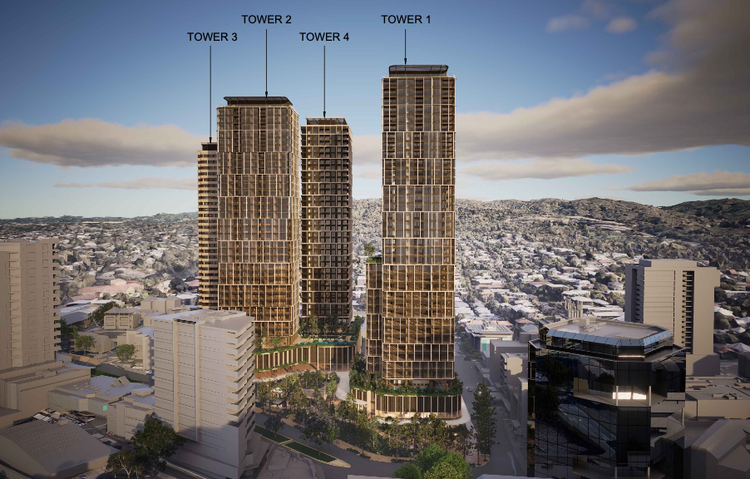
ABOVE: Artist’s impression of the amended four-tower Toowong Central scheme against the Brisbane skyline — two build-to-sell towers, one build-to-rent and one student-accommodation tower. Source: Verso Development Group / Kerry Hill Architects.
Brisbane’s inner west is on the cusp of one of its most significant transformations. Plans have now been unveiled for Toowong Central, a proposed $1 billion mixed-use precinct featuring three landmark towers, expansive public spaces and more than 1,100 new residences. Currently in its community feedback stage, if approved, the project would reshape the skyline and significantly change the lifestyle offering of Toowong.
Development Comparison
Toowong riverfront: two development schemes
Drag the handle to compare the two proposed schemes from the same vantage point on the green bridge.
Drag to compare · arrow keys also work
The Original Proposal at a Glance
- Towers Three residential towers ranging from 49 to 58 storeys
- Homes Approximately 1,100 apartments, from one to four bedrooms plus penthouses
- Site A prime 14,000sqm site bounded by Sherwood Road, Jephson Street and High Street
- Retail Around 12,000sqm of retail and dining, including a supermarket, cafes and specialty stores
- Green Approximately 4,500sqm of green space, plazas and laneways
- Status Superseded by amended plans lodged 3 July 2026 — see ‘The Response’ below
The Vision
Proposed by Verso Development Group in partnership with IJ Capital, the project occupies a prime 14,000sqm site bounded by Sherwood Road, Jephson Street and High Street. Designed by Kerry Hill Architects, the development application includes three residential towers ranging from 49 to 58 storeys, approximately 1,100 apartments spanning one to four bedrooms plus penthouses, around 12,000sqm of retail and dining space including a supermarket, cafes and specialty stores, commercial office space integrated into the podiums, and approximately 4,500sqm of green space supported by landscaped plazas and laneways.
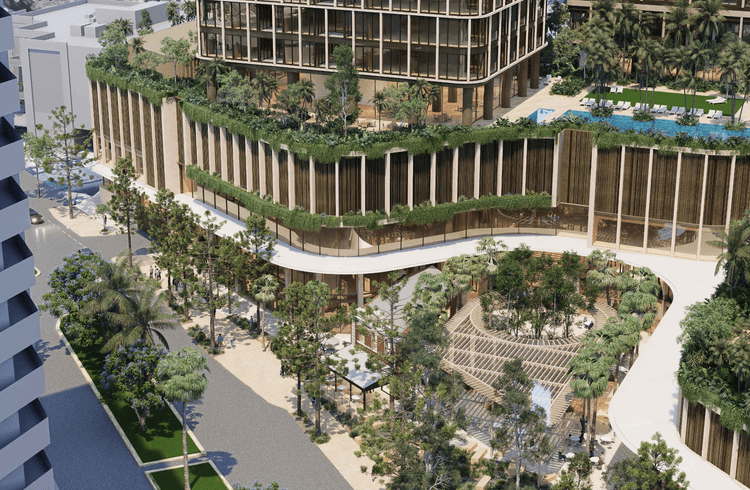
ABOVE: Aerial view of the podium gardens, rooftop pool and landscaped terraces proposed for the precinct.
Design and Lifestyle Features
Toowong Central has been positioned as more than just a high-density residential project. The proposal includes four distinct civic spaces — Sherwood Plaza, High Street Park, Central Plaza and Jephson Terrace — all connected by walkable laneways and public realm improvements. The design also incorporates subtropical landscaping through rooftop gardens, podium planting and slot gardens within the towers themselves.
Residents would have access to lifestyle amenities such as pools, gym facilities, rooftop terraces and generous communal spaces. There is also a heritage component, with historic structures such as Carver & Co proposed to be retained and adaptively reused. Sustainability measures flagged within the proposal include rooftop solar, external shading, stormwater reuse and waste recycling initiatives.
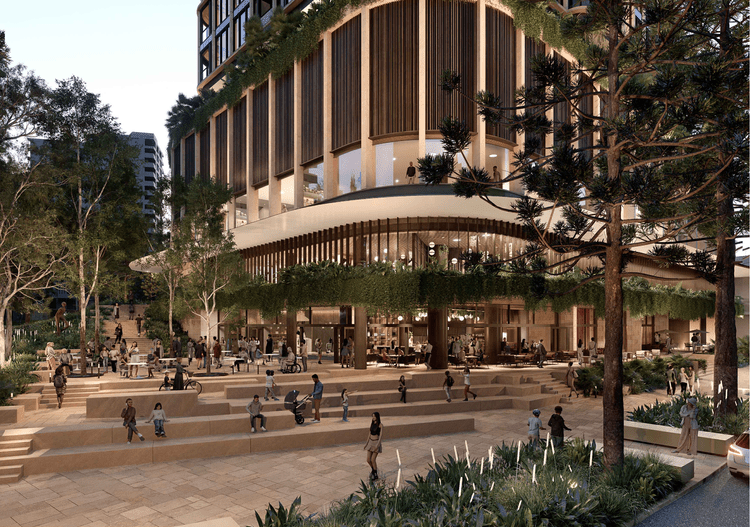
ABOVE: An evening view of the proposed Central Plaza, with dining and gathering space beneath the landmark pavilion.
Connectivity
One of the project’s strongest features is its location. The site sits immediately adjacent to Toowong Village and Toowong train station, and is close to the Bicentennial Bikeway and several major bus routes. The proposal also includes plans to improve pedestrian connectivity and reconfigure parts of Sherwood Road to better manage access and movement around the site.
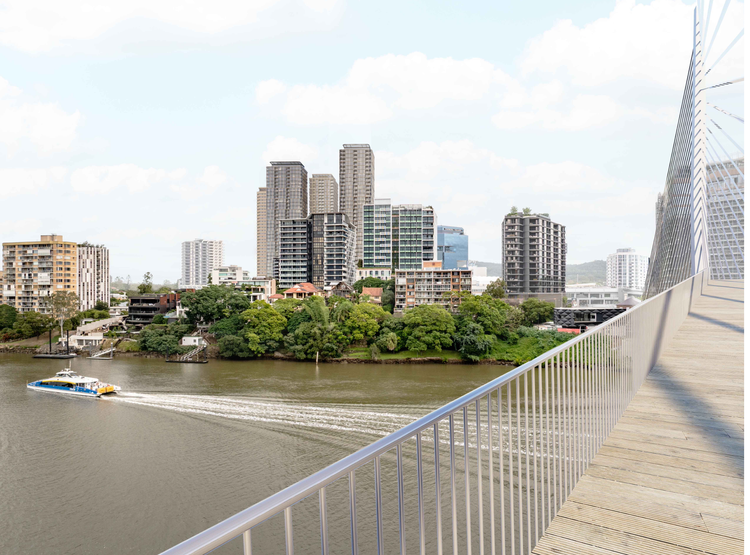
ABOVE: The precinct’s riverside setting — Toowong sits on the Brisbane River beside the Bicentennial Bikeway and CityCat network, minutes from the CBD.
For future residents, this points to a more walkable and potentially car-light lifestyle, with strong access to the CBD, major education hubs and surrounding amenity.
Community Conversation
As expected for a project of this scale, the proposal has already generated discussion around its broader impact on the suburb. At up to 58 storeys, the towers would become some of Brisbane’s tallest outside the CBD, which naturally raises questions around built form, skyline change and neighbourhood character.
Traffic and infrastructure are also likely to be major points of debate. Introducing around 1,100 households into this part of Toowong will place additional pressure on local roads, services and public infrastructure. While higher density close to transport is sensible in principle, the practical question is whether the surrounding road network has been given enough consideration.
“Toowong is not simply accessed by locals and nearby workers — it is a key gateway to the western suburbs, and already absorbs substantial daily traffic movement.”
Agent’s perspective — Brisbane Inner WestThat issue feels particularly relevant in Toowong because the suburb does not only serve its own local population. It also acts as a gateway to the western suburbs, with thousands of residents moving through the area each day. That makes the conversation here slightly different to similarly scaled precincts such as West End Village or Newstead Gasworks, which do not carry the same level of through-traffic pressure.
The Hurdle: What Brisbane City Council Has Asked For
That community conversation is no longer just theoretical. On 8 May 2026, Brisbane City Council issued a formal ‘further advice’ letter on the application (reference A006836692) following public notification. Rather than waving the plans through, Council identified a lengthy list of matters — 48 in total — requiring amended plans and additional information before the proposal would be consistent with the expectations of the Major centre zone and the Toowong–Auchenflower Neighbourhood Plan under Brisbane City Plan 2014. It is not a refusal, but it is a significant roadblock: the project cannot meaningfully progress until the developer reworks several key elements and responds.
The single biggest sticking point is height. Council considers the proposed towers a clear departure from what is anticipated for the site, noting that “Toowong centre does not form part of the inner city context” and is therefore not intended to carry inner-city densities, heights or built form. The proposed heights are also expected to cast extended overshadowing. On top of that, the six-storey podium fronting Sherwood Road exceeds the four storeys anticipated in the neighbourhood plan and, at roughly 26 metres, is described as “imposing” to the street. Council has asked for a revised proposal with lower, more contextual building heights.
Council’s Key Concerns
- Height Towers exceed the heights anticipated for Toowong centre, with extended overshadowing expected
- Podium Six-storey Sherwood Road podium (~26m) is “imposing” versus the four storeys anticipated
- Heritage Gutting, building over and excavating beneath the Carver & Co building risks its heritage values and footings
- Activation Sherwood Road frontage is dominated by lobbies rather than the active retail and dining expected
- Public realm The ‘Toowong Watering Hole’ does not deliver the activated precinct heart at Sherwood Rd & High St
- Setbacks Tower 3 sits just 3.6m from the boundary and may prejudice neighbouring sites
- Traffic A 0% traffic-growth assumption was rejected, parking is oversupplied, and a key intersection fix was not supported
Heritage is another major theme. Council raised serious concerns about the proposed gutting and stripping of the historic Carver & Co building, the plan to build over and below it, and excavation beneath its original Brisbane Tuff footings — warning the current design could substantially impact the heritage values of the place. The proposed demolition of the building’s internal stairs and half of its upper floor was found to lack valid justification under the Heritage overlay code, and building around the structure would erode its setting and visibility in the High Street streetscape. Council wants the heritage place better respected, restored and sensitively integrated.
The letter also pushes hard on street life. The Sherwood Road ground level is dominated by hotel, office and residential lobbies rather than the active, small-scale retail and food and beverage uses expected on what the plan treats as a primary frontage. Relatedly, the proposed ‘Toowong Watering Hole’ public space was found not to deliver the vibrant, equitable ‘precinct heart’ the neighbourhood plan envisages for the corner of Sherwood Road and High Street, partly because of its location away from the retail precinct and the access barrier created by extensive stairs.
“Toowong centre does not form part of the inner city context and is therefore not intended to have similar densities, heights or built form as that found in inner city locations.”
Brisbane City Council — Further Advice, 8 May 2026Beyond these headline issues sit dozens of more technical requirements: increasing tower setbacks so neighbouring sites can still achieve the required separation, enlarging and relocating the urban common, committing to public art, and a long run of transport matters — Council rejected the report’s 0% traffic-growth assumption as unreasonable, flagged an oversupply of non-residential parking at double the maximum rate, and did not support a proposed mitigation at the Sherwood Road/High Street intersection. Add to that road dedications, loading and waste-servicing redesigns, stormwater and overland-flow investigation, a request to lift deep planting above the current 6.2%, and noise concerns around co-located uses, and the scale of the rework becomes clear.
In practical terms, the ball is now back with the developer and its consultants. Addressing this volume of feedback — most importantly a meaningful reduction in height and a reworked heritage and street-level design — is likely to take months, and there is no guarantee the amended scheme will resemble the towers first unveiled. For now, the timeline for any decision is genuinely uncertain.
The Response: Amended Plans Lodged
That community conversation did not stay theoretical for long. On 26 June 2026 — and formally received by Council on 3 July — the developer lodged an amended architectural set under the same application (A006836692), and it is a genuine rework rather than a light revision. The two issues Council pushed hardest on have both moved. The towers are lower, dropping from the original 49–58 storeys to roughly 33–39, and the Sherwood Road podium comes down from six storeys to four or five. On paper, that is a direct answer to the height, overshadowing and ‘imposing’ street-wall concerns.
The shape of the scheme has changed just as much. What was three towers is now four, and the housing mix has been re-pitched across different product types. Towers 1 and 2 remain build-to-sell apartments (269 and 249 homes respectively); Tower 4 becomes a build-to-rent tower of 341 apartments; and Tower 3 is reworked into purpose-built student accommodation of around 702 bed spaces. All told, the amended scheme carries roughly 1,560 dwellings and student beds — more than the original ~1,100 — achieved by adding a fourth tower and by using student accommodation to pack more beds into fewer levels. HTA now joins Kerry Hill Architects on the design team, taking Towers 3 and 4.
So the reworked design is lower and less bulky at the top, but denser overall, and re-pitched away from a purely owner-occupier product toward rental and student housing. Whether that fully answers Council is the open question: the reduced height and lower podium address built form and overshadowing, but a higher total yield may relocate the density debate rather than settle it. And the architectural drawings on their own do not confirm how the heritage treatment of Carver & Co, the tower setbacks or the traffic response have changed — those sit in the amended reports still to be worked through.
Original vs Amended — What Changed
- Towers Three → four towers
- Height 49–58 storeys → roughly 33–39 (Tower 1 tallest); final count subject to confirmation
- Podium Six storeys (~26m) → four to five storeys
- Homes ~1,100 apartments → ~1,560 dwellings & beds: 518 for-sale (Towers 1 & 2), 341 build-to-rent (Tower 4), 702 student (Tower 3)
- Tenure Owner-occupier apartments → build-to-sell + build-to-rent + student accommodation
- Design team Kerry Hill Architects → KHA (Towers 1 & 2 & podium) with HTA (Towers 3 & 4)
- Lodged Amended plans 26 June 2026, received by Council 3 July
NOTE: Figures above are drawn from the amended architectural set (Kerry Hill Architects, dated 26 June 2026). Storey counts are ‘technical storeys as defined’ and the drawings note the final count is subject to confirmation.
What This Means for Toowong Property Owners
For homeowners and investors in Toowong, as well as neighbouring suburbs such as St Lucia, Taringa and Indooroopilly, the Toowong Central proposal is more than just a skyline story. It has direct implications for the local property market.
Projects of this scale tend to attract significant buyer attention, not only to the development itself but also to the surrounding housing, townhome and unit markets. Buyers drawn to improved amenity, retail, dining and transport often widen their search radius once they become more engaged with a suburb.
There is also the potential for flow-on value growth. Comparable projects near key transport and retail nodes, such as The Ambrose in Milton or West Village in West End, have helped strengthen surrounding property values over time. While every precinct is different, there is a reasonable argument that Toowong could experience a similar uplift if this project gains momentum and successfully activates the suburb.
Developments of this nature also tend to change buyer demographics. Professionals, downsizers and investors are often drawn to new mixed-use precincts, which broadens the buyer pool and can intensify competition across neighbouring established stock. Perhaps just as importantly, retail activation, dining offerings and laneway-style public spaces can materially improve a suburb’s lifestyle appeal — which historically has supported stronger demand for nearby established homes and investment properties.
“Market energy tends to rise around major projects like this. Even if you are not planning to sell in the short term, staying informed could help you stay ahead of the curve.”
Local Property InsightFinal Thoughts
The unveiling of Toowong Central is more than just another development application. It represents a broader vision for how Brisbane’s established suburbs may evolve over time, becoming denser, greener and more connected. For residents, investors and business owners in Toowong, this billion-dollar proposal could mark the beginning of a very different chapter for the suburb.
That said, from a density point of view, one of the biggest questions remains whether enough consideration has been given to the roads surrounding the development. Toowong is not simply accessed by locals and nearby workers. It is a key gateway to the western suburbs and already absorbs substantial daily traffic movement. That makes traffic impact, road capacity and broader infrastructure planning far more important here than in other large-scale precincts around Brisbane. The opportunity is significant, but so is the need to get the balance right.
⚠ Disclaimer: Images are artist’s impressions of the proposed Toowong Central development by Verso Development Group and are subject to change and planning approval. This article is general information only and does not constitute financial, property or legal advice.